
Quote the President
The norms are gone. Journalism is still following them--at a cost to the audience.

On Easter morning, the President of the United States posted this to social media:
“Tuesday will be Power Plant Day, and Bridge Day, all wrapped up in one, in Iran. There will be nothing like it!!! Open the Fuckin’ Strait, you crazy bastards, or you’ll be living in Hell — JUST WATCH! Praise be to Allah. President DONALD J. TRUMP.”
A threat to bomb civilian infrastructure in a sovereign nation using “Fuckin’”. On Christianity’s holiest day. Signed with a mocking invocation of Islam.
Across broadcast news media, most anchors and correspondents took the same approach: don’t say it.
“Using some colorful language.” “Profanity-laced.” “I’m not going to read it.” “You can see it on screen.”
All these contortions without actually reading the post.
Journalists need to follow the fundamentals of their craft. Is it relevant? The president said it. Is it newsworthy? He’s threatening to destroy power plants and bridges. Does the language matter? He’s addressing a foreign government the way you’d threaten someone in a bar fight — while his faith adviser compares him to Jesus. Does softening the words change the meaning?
Yes to all. So you don’t soften them.
By substituting euphemisms for the actual quote or paraphasing, reporters make the president’s words sound more benign and cogent than they are. “Colorful language” is what your uncle uses at Thanksgiving, not what a commander-in-chief uses to threaten war. When a news organization doesn’t share the full post but references it like this, they force consumers to go find the actual quote somewhere else. Self-defeating as a news outlet. But more importantly, the outlet had the information and decided you shouldn’t hear it from them. Ultimately they mischaracterized the story they were covering. That is the opposite of journalism.
Kudos to Jake Tapper, who read the post verbatim on CNN. He warned viewers in advance, “If your children are watching, be warned” and then he quoted the president in full. Fareed Zakaria did the same. MSNBC’s Eugene Daniels initially demurred, then read it aloud and said what shouldn’t need saying: “That is a quote from the president, so yes, we are saying it on television.”
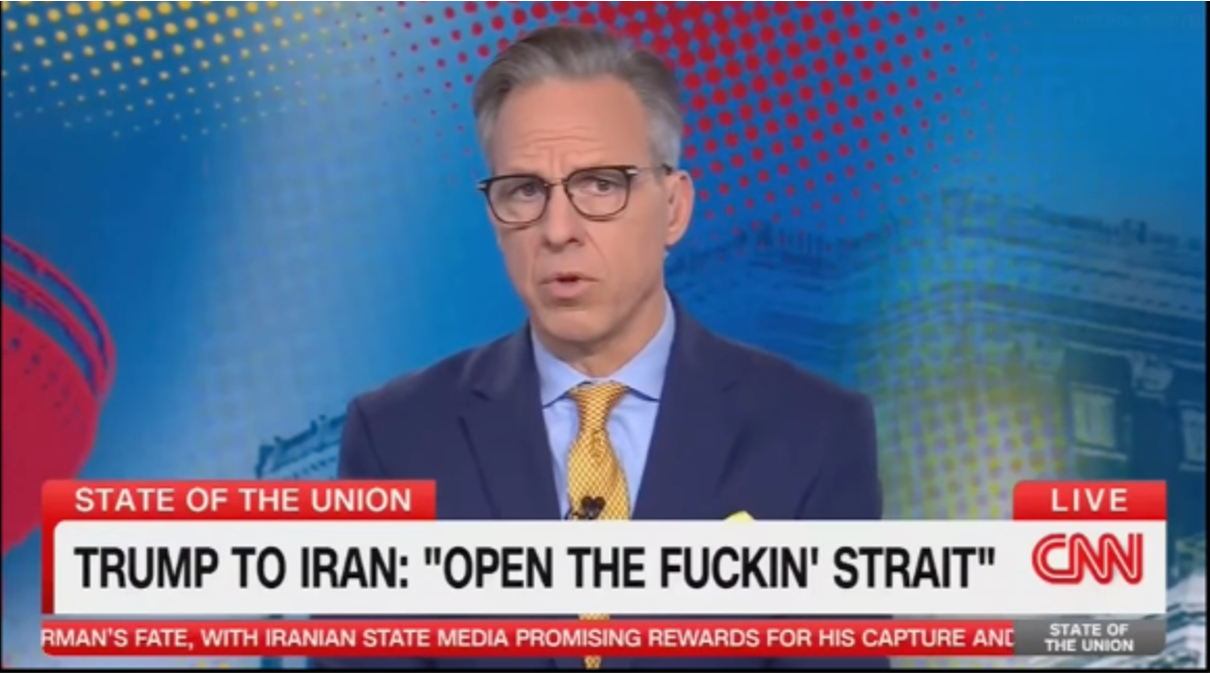
There are two things happening here, and they’re both problems.
The first is inertia. Newsrooms have style rules about profanity on air. Those rules exist for good reason — most of the time. But editors need to stop and ask whether the rule still applies when the president of the United States is the one using the language and the language is part of a geopolitical threat. This is the same broader pattern that has defined the last decade of Trump coverage: he breaks a norm, journalists keep following it, and by the time the newsroom catches up, the damage is done. The audience has already received a sanitized version of something that should never have been sanitized. News organizations took years trying to decide when to name a lie a lie. Trump has been successful in part because journalism keeps applying yesterday’s conventions to a president who abandoned them years ago.
The second is fear. The FCC prohibits profane content on broadcast television between 6 a.m. and 10 p.m. — but that rule doesn’t apply to cable. But even on broadcast, quoting the president’s own public statements in a news context is not gratuitous profanity. News organizations know this. But the head of the FCC has openly sought to use the agency to punish broadcasters he considers unfair to the president. If the calculus of pressure from the FCC or the White House is shaping editorial decisions — even unconsciously — then the problem isn’t decorum. It’s independence.
A journalist’s job is to report the news. Not to shy away from it. Not to sand the edges off a story because the president’s own words feel inappropriate or make the story harder to tell.
This is part of the insight series at Alchemy Communications & Consulting. Read more at alchemy-communications.com